
CLAT Rank & NLU Predictor
The CLAT Community Rank & NLU Predictor has therefore been designed to give students a more realistic picture of where they currently stand. You can access the spreadsheet here..
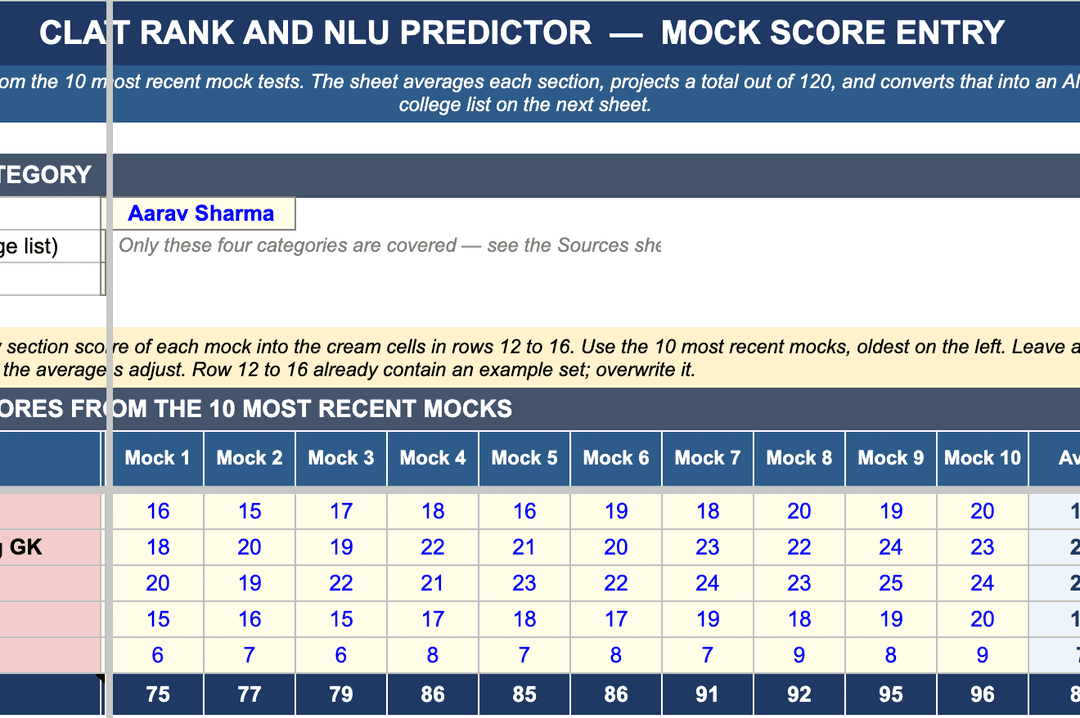
CLAT Rank & NLU Predictor: How to Use the Spreadsheet
One of the biggest problems during CLAT preparation is that students keep giving mocks without actually knowing where their current performance places them. A score of 75, 85 or 95 means very little in isolation because mock difficulty changes, institutes prepare papers differently, and performance naturally fluctuates from one test to another.
The CLAT Community Rank & NLU Predictor has therefore been designed to give students a more realistic picture of where they currently stand.
You can access the spreadsheet here:
CLAT Rank & NLU Predictor:
https://docs.google.com/spreadsheets/d/1Tluis-RBluBzhi4tOa9AZijPP0xnk7TtcKu3EaHWjMY/edit?gid=1943985009#gid=1943985009
The spreadsheet is completely free to use. You do not need to register anywhere or provide any personal information.
How does the Rank Predictor work?
The predictor does not rely on a single mock score. Instead, it calculates your performance using your latest 10 mocks. For each mock, enter your section-wise scores in the spreadsheet for English Language, Current Affairs including General Knowledge, Legal Reasoning, Logical Reasoning and Quantitative Techniques.
The spreadsheet then calculates your average performance in each section as a percentage of the total marks available in that section. These percentages are subsequently adjusted according to the actual CLAT paper structure to generate an overall projected CLAT score.
Using 10 mocks instead of one or two is important because individual mocks can vary significantly in difficulty. A particular Legal section may be unusually difficult in one mock while another institute may produce an extremely easy GK or English section. Averaging performance across several mocks reduces the impact of these abnormalities and provides a much more useful estimate of your present preparation level.
Use at least 10 mocks
You should ideally enter 10 mocks before relying on the predictor. Anything substantially below this provides too small a sample to properly assess your performance.
If you are following the recommended schedule of approximately three mocks every week, you will generate an almost completely new dataset roughly every three weeks. This means you can continuously update the predictor and compare your current preparation with your performance three weeks earlier.
Your predicted score is therefore not permanent. It represents where your preparation stands right now.
Do not use mocks from only one institute
Your 10 mocks should ideally include papers from at least six different institutes or mock providers.
Do not enter ten mocks from CLAT Community alone, or ten mocks from any other single institute. Every institute has its own tendencies regarding difficulty, passage length, GK selection and question construction. Using multiple institutes makes the dataset substantially more representative and prevents your prediction from becoming dependent upon the particular style of one mock series.
What scores does the spreadsheet give you?
Once your mock scores have been entered, the spreadsheet automatically performs the calculations. You only need to enter your scores; do not alter the formulas or other cells.
The predictor generates different projections representing your likely performance.
Your Expected Score is deliberately conservative. Approximately five marks are deducted from the projected average to account for factors such as pressure, stress and mistakes that can arise in the actual CLAT examination hall. The spreadsheet also indicates the level you could reasonably move towards with consistent preparation and improvement.
Finally, the Best-Case Scenario represents what your performance could look like if your preparation, accuracy and examination execution go particularly well.
These numbers should not be treated as permanent ceilings. If you improve substantially over the next few weeks, your next set of ten mocks will produce an entirely different prediction.
College Predictor
The spreadsheet does not stop at predicting your score.
Based on your projected performance, the NLU Predictor helps you understand your position relative to different National Law Universities. Depending upon the relevant score range, an NLU may appear as something you are likely to secure, borderline for, unlikely to secure or comfortably placed for.
This is especially useful because preparation becomes much easier when you have an actual benchmark. Instead of simply thinking, “I need to improve my CLAT score,” you can understand approximately how much improvement may be required to move into contention for a particular NLU.
NLU Cut-Off Data
The spreadsheet also contains consolidated NLU cut-off information from CLAT 2025 and CLAT 2026.
The data is organised NLU-wise and category-wise so that students can examine previous admission trends according to the reservation category applicable to them. This becomes particularly useful when evaluating whether a particular rank may historically have been sufficient for an NLU rather than relying on random cut-off figures circulated online.
Score-to-Rank Predictor
Another part of the spreadsheet contains a Score-to-Rank conversion, based primarily on CLAT 2025 data. This allows you to take your projected score and understand the approximate rank range associated with it.
The methodology, assumptions and sources used for these calculations are also provided towards the end of the spreadsheet for students who want to understand how the estimates were generated.
How should you actually use the predictor?
The Rank Predictor should not become something you check after every mock. Its real value comes from tracking movement over time.
Complete approximately ten mocks, preferably across several institutes, enter the section-wise scores and note your projected score and NLU position. Then continue preparing.
After roughly another three weeks of consistent preparation and mocks, replace the older results with your latest ten mocks and calculate again. If your preparation is working, your projected performance should gradually move upwards. If your overall score remains stagnant, the section-wise averages will also help identify exactly where the problem lies.
The purpose of the spreadsheet is therefore not simply to predict whether you will get an NLU. It is to give your CLAT preparation a measurable sense of direction. Mocks tell you how you performed on one particular afternoon. The Rank Predictor attempts to tell you what those performances collectively say about your current CLAT preparation.
Use it periodically, keep the data honest, diversify the mocks you take, and allow your latest ten papers—not your best paper—to determine where you currently stand.
Access the CLAT Community Rank & NLU Predictor here:
https://docs.google.com/spreadsheets/d/1Tluis-RBluBzhi4tOa9AZijPP0xnk7TtcKu3EaHWjMY/edit?gid=1943985009#gid=1943985009
Regards,
Team CC

Create an account
to continue reading
It's FREE. And you'll unlock daily resources used by serious CLAT aspirants — delivered every single day.