
The Dogs of NALSAR
A freshers guide to the dogs of NALSAR
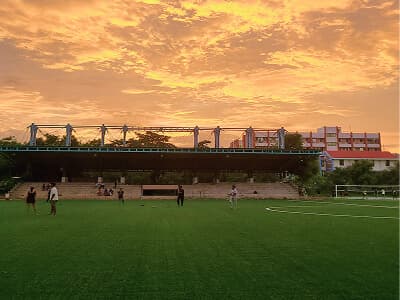
I came to NALSAR afraid of dogs. Not in a dramatic way — I wasn't going to climb a wall — but in the quiet, practical way of someone who has spent their whole life calculating the shortest path across a street when a stray is lying on it. I crossed roads to avoid them. I read their tails wrong. A dog trotting cheerfully in my direction registered, in my body, as a threat requiring immediate exit.
The fear did not go quietly. My first weeks were an elaborate choreography of avoidance — noting where each dog usually lay, timing my walks to the library, treating the stretch outside the mess as contested territory to be navigated at speed. The problem with this plan is that there is no route through NALSAR that a dog has not already claimed. They are everywhere, unhurried, entirely at ease, and my careful little detours were, I slowly realised, being observed. Not with menace. With something worse: mild, patient curiosity, the way you'd watch a first-year take the long way around a puddle that isn't there.
They have names, and the names told me early that I'd misjudged the whole species. These are not dogs called Bruno or Max. These are Daru, Sutta, and Fatty — christened, one assumes, at some godless hour by students who looked upon a stray and saw a kindred spirit. There is a dignity to it, in its way. Somewhere a golden retriever named Cooper is being walked on a leash in a gated colony, and here is Sutta, unbothered, unleashed, holding court outside the mess with the moral authority of a creature who has never once been told what to do and does not intend to start. It is very hard to stay frightened of something called Fatty. That was, I think, the first crack in the wall.
The feeding is what dissolved the rest. There's no organised system — nobody is refilling water bowls, that's a fiction I won't insult you with — but the food happens, every single day, without fail. Plates from the mess find their way out. Somebody's leftover parathas, somebody's untouched dinner after a bad day, a quietly bought packet of biscuits. And at some point, almost without deciding to, I was carrying a plate too. I still remember the specific terror of the first offering — arm fully extended, biscuit held at maximum distance, ready to retreat. Daru took it with a gentleness that made my caution look faintly ridiculous, which it was. You cannot feed something every day and stay afraid of it. The body learns what the mind was too anxious to test.
What finished the job was watching how completely they own the place. A NALSAR dog does not ask permission. It attends class. Fatty will walk into a lecture on jurisprudence, survey the room, and lie down in the exact centre of the aisle with the settled confidence of tenure. The professor teaches around him. We take notes around him. And somewhere in my second month, watching this, the whole thing flipped in my head — the fear I'd arrived with had the entire situation backwards. I'd been moving through campus as though the dogs were intruders in my space. They are not the intruders. We are. This is their campus; they were here before this batch and will be here long after we've scattered into chambers and firms and LLM applications. We are the strays, really — turning up for a few years, loud and anxious and convinced of our own importance, squatting on floors that belong to them. The dogs are the residents. They have simply been generous enough to let us stay.
And occasionally they remind you, spectacularly, of exactly whose turf you're on. There was a comedy show — a proper one, lights, a mic, a visiting act, the whole campus turned out. Somewhere mid-set, at a moment of maximum attention, one of the dogs ascended the stage with total composure and, in front of the entire audience, calmly relieved himself. On the stage. During the show. The comic never stood a chance; there is no punchline in the human language that competes with a dog delivering unsolicited critique in that particular medium. The place came apart. And the dog simply left, unhurried, the way he'd come — a reviewer who had filed his verdict and felt no need to elaborate. I laughed harder than anyone, and it struck me later that a few months earlier I'd have been the one flinching as he climbed the steps. Now he was just Sutta, being Sutta, on his own stage.
The final surrender happened at 3 a.m., as these things do. The night before a submission, library glowing, everyone past pretending to be okay — and Daru appeared at the door, padded over, and rested his head on my knee. The old me would have frozen. This me went completely still for an entirely different reason: I did not want him to move. A warm, unbothered animal had decided my knee was an acceptable pillow, and it did more for my state that night than any amount of caffeine, and asked for nothing except that I stay put. A reasonable ask. I did not move. I sat there, a person who used to cross roads to avoid this exact creature, letting him sleep, absurdly, deeply grateful.
So no — the Constitution guarantees them nothing. No fundamental right to the mess veranda, no due process before eviction from a lecture hall, no leash, no collar, no name their own species would recognise as sensible. And yet they hold their ground more securely than any of us hold ours, governed by no statute, protected by nothing but the unbroken consensus of every batch that has passed through and understood, sooner or later, the thing it took a lifelong dog-fearer three months to learn:
It's their campus. We're just the strays passing through.
(An honourable mention is owed to the monkeys of the GK, who operate a parallel and far more lawless regime on the other side of campus — but that, thankfully, is a fear I have not yet had to overcome, and a matter for its own thread.)

Create an account
to continue reading
It's FREE. And you'll unlock daily resources used by serious CLAT aspirants — delivered every single day.